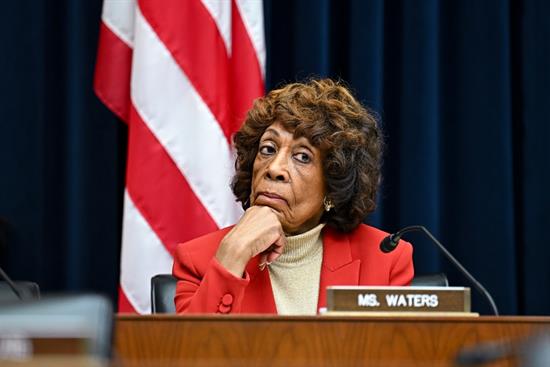
Rep. Maxine Waters, D-Calif., who serves as ranking member of the House Financial Services Committee. Bloomberg News
When Democrats swept the 2026 midterm elections, the party regained a solid control of Congress and the gavels of committees that oversee and make rules for banks.
In the House, that means Rep. Maxine Waters is back. The tenured lawmaker has represented her California district for three and a half decades, and has been the top Democrat on the House Financial Services Committee for 13 years. While she’s a familiar, if not always a friendly, face behind the podium for the nation’s banks, she’s joined by progressive allies like Sen. Elizabeth Warren, D-Mass., who’s next in line to lead the Senate Banking Committee, and enjoys support from her caucus to dig into the Trump administration and its financial relationships with private companies.
Waters does face a challenge for the gavel of the powerful committee in Rep. Sean Casten of Illinois. He is, however, still viewed as an underdog in the race by K Street, and Waters has the benefit of strong support from the influential Congressional Black Caucus, as well as more senior members of the committee.
Waters, in a conversation with American Banker, talked about how she would steer the panel should she win control of it. Democrats in both the House and the Senate will focus on oversight — with legislation being difficult to pass without a filibuster or veto-proof majority — but Waters is noted for her relationship with leading banking Republicans like current committee Chair French Hill, R-Ark.
She outlined issues where she might work across the aisle, such as deposit insurance reform, and where she will turn her oversight attention toward the private sector, notably involving cybersecurity concerns among the country’s largest banks. She wants to steer the committee toward a focus on housing, and said she would work on issues ranging from artificial intelligence in the financial sector to Federal Reserve master account access.
What follows is a transcript of the conversation between American Banker and Waters, edited for length and clarity.
American Banker: One of the things our readers are most interested in hearing about is oversight and the degree to which the Trump administration, as well as private industry, will be targets of that oversight. Can you talk a little bit about that? Give us a little bit of a preview of what your agenda looks like on oversight for industry in the next Congress.
Maxine Waters: Let me just say this: Oversight is the top mission of what we have the responsibility to do in our committee. We have to make sure that we hold the hearings, that we create legislation, that we call in witnesses to talk about the top issues, and that we get something done.
There has been extraordinary deregulation. We have to correct that. We look at how we can further help our small banks to thrive and to be able to service our communities and our neighborhoods.
Are there any specific agencies or any specific industries you’re interested in overseeing?
Well, we are concerned about the banks. We are concerned about what has happened recently, where we had the banks that were basically invaded for all intents and purposes. We need to understand what is happening and how to protect our banks from cyber attack.
We’re very interested in private equity, AI and asset managers. We know that there are some issues between AI and the banks, and trying to make sure that we understand that the banks do not want this competition necessarily with stablecoins being able to give interest. It just doesn’t work right for the banks, in particular the small banks.
A lot of bankers say that the industry got out of the housing mortgage finance space after Dodd-Frank. Is that something you’re open to look at to get the banking industry more involved as opposed to nonbank financers?
No, I’m not worried about that, and I haven’t seen any proof of that. We think that the bankers are interested in mortgages but I think they want the larger mortgages, and we want rural, small towns, suburbs, urban areas, everybody to have the opportunities for home mortgages.
You had a brief mention in your Dear Colleague letter of Federal Reserve master accounts and expanding access to them. Can you elaborate a little bit more on that? Who should we be expanding access to Federal Reserve master accounts to?
We were sitting here with my staff just talking about the fact we should revisit, we think that’s very important, and certainly reforms are needed. Absolutely.
Do those reforms come in the form of legislation?
I think so. I think we want to include that. We want to make sure that we take a good look and that we’re not excluding the possibility. We think that it is so possible for us to be able to solve some of the issues that have occurred.
Tell me a little bit more about your views on community bank deregulation. It seems like that’s an area where you and current Chairman Hill worked very well together. Talk to me a little bit about what you would do as chair to help banks under that $10 billion threshold?
I want to help community banks with deposit insurance. We think that’s an important issue. We have support on both sides of the aisle. We just haven’t agreed on the amounts yet, but we do believe that is something that’s going to happen. It’s been years since we’ve increased federal deposit insurance, and we do know that there’s a good reason to do it.
Times have changed, the economy has changed, and it makes good sense for us to keep up with what is happening in the economy and to give depositors some assurance that if there’s a run on the banks, if something happens that the banks all of a sudden do what Silicon Valley Bank did, that the deposits will have some support.
We need community banks and credit unions. Period. They helped during the pandemic, and I want to help them. This is a very important time for banks and credit unions not only to receive support, but to show what they can do once they get the resources and the support that they need.
Are we going back and starting from scratch on deposit insurance, or are you open to taking up any specific bill that’s already been in the Senate?
I don’t think we’re starting from scratch. A lot of work is going on. A lot of discussion is going on. I think we have support from both sides of the aisle to do something, and there’s recommendations that maybe I’m interested in that we can increase to $10 million, and we’re going to keep working. I think we’ve come a long way, and we’re going to have something coming out of this Congress for sure.
You had in your Dear Colleague letter a mention of an AI financial services bill. In your mind, what does that look like?
Well, I don’t know, but let me just say this: that it is an issue, a very controversial one, that’s got to be dealt with. It’s real, and of course, we have a lot of rumors about what it is and what it is not, and we’ve got to make sure that we are developing the experts and utilizing the experts to make sure that we have some guardrails. We’ve got to learn a lot about the agents and what their power is and what they’re doing. We are already getting a lot of information about the possibility of job loss, and so we’ve got a lot of work to do.
We have to be very careful about all these investments that are going to AI because we could end up with a problem that we don’t want to have to deal with. We have bailout concerns. We have a bill already that basically says we’re not bailing out firms because of a bubble that is created with all these investments. And of course, the whole liability issue has just got to be dealt with. It is now on the table for discussion, but no real solutions have come yet about how to deal with liability and with the agents and what they do or don’t do, etc. AI is a big issue, and we’re going to deal with it. It’s at our agenda, top of our agenda.
###

