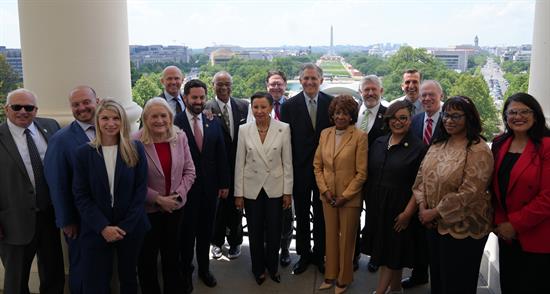 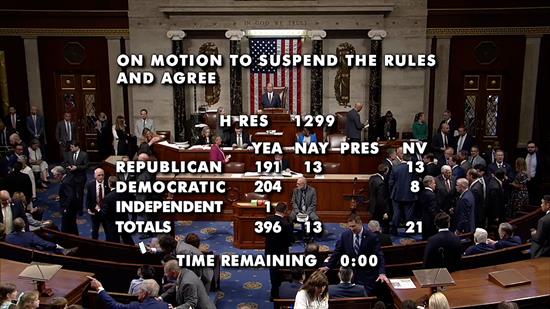
WASHINGTON, D.C. - This week, the House passed the “21st Century ROAD to Housing Act,” led by the House Committee on Financial Services Ranking Member Maxine Waters (D-CA), Chairman French Hill (R-AR), Subcommittee on Housing and Insurance Ranking Member Emanuel Cleaver (D-MO), and Subcommittee on Housing and Insurance Chair Mike Flood (R-NE). The Members issued the following statements after the House passed by a vote of 396-13 H .Res. 1299, the “21st Century ROAD to Housing Act, as Amended,” a comprehensive bipartisan housing package aimed at expanding affordable housing, strengthening pathways to homeownership, and addressing the nation’s worsening housing and homelessness crisis.
Ranking Member Maxine Waters (D-CA) said, “This housing bill is the result of a broad, bipartisan and bicameral legislative process, and is a huge step towards finally addressing the affordable housing and homelessness crises in this country. Americans deserve the peace of mind that comes with having a roof over their heads, the opportunity to build wealth through homeownership, and the dignity of knowing that working hard should be enough to afford a place to live. I am beyond proud of this legislation and the benefits it will bring to all of our cities, counties, and states. The Senate must meet this moment with the same urgency and determination and quickly pass this bill. The American people deserve action, not more delays.”
Chairman French Hill (R-AR) added, “Today, we proved Washington still works. After months of bipartisan, bicameral negotiations – and with the partnership of the Trump Administration – the House delivered to make housing more accessible and affordable for American families. I urge the Senate to move expeditiously to get our amended bill to President Trump’s desk and deliver the relief Americans have been waiting for.”
House Democratic Leader Hakeem Jeffries (D-NY) stated, “America is facing an unprecedented housing crisis that is making it increasingly more difficult for working families to keep a roof over their heads and placing the dream of homeownership further out of reach for everyday Americans. The 21st Century ROAD to Housing Act, which passed the House with overwhelming bipartisan support, will help increase the housing supply, lower costs for families and make necessary reforms that strengthen and protect communities across the country. I thank Ranking Member Waters for her leadership and urge the Senate to take this legislation up and send it to the President’s desk immediately.”
Speaker Mike Johnson (R-LA) stated, “The 21st Century ROAD to Housing Act is transformational legislation that will immediately address the housing affordability problem and bring the American Dream back within reach for millions of young and working American families. This bill delivers on our promise to reduce restrictive regulations, increase the housing supply, limit institutional investing in the housing market, and drive down the price of homes nationwide. Chairman Hill, Ranking Member Waters, and the entire House Financial Services Committee did exceptional work to achieve a bipartisan product that delivers the housing policy President Trump has called for and that voters demand. We are grateful that a strong, bipartisan majority of the House voted to pass this legislation today, and we urge the Senate to swiftly do the same.”
House Democratic Caucus Chair Pete Aguilar (D-CA) said, “The affordable housing crisis in this country demands urgent action. That’s why I’m so proud the House of Representatives took the important step in passing the 21st Century Road to Housing Act to improve access to more housing for Americans. I’m grateful for the leadership of Chairman Hill and Ranking Member Waters who worked across the aisle to get this critical legislation across the finish line. This is how Congress should work. I look forward to the Senate acting swiftly to send this bill to the President’s desk.”
Majority Leader Scalise (R-LA) added, “House Republicans are focused on making the American Dream more attainable again for hardworking families. After years of rising costs and burdensome regulations driving homeownership further out of reach, the 21st Century ROAD to Housing Act takes meaningful steps to increase the supply of homes and cut the red tape standing in the way. I’m grateful to Chairman French Hill, Subcommittee Chair Mike Flood, and the Financial Services Committee for their leadership in drafting real solutions that will help more Americans buy a home and build a better future for their families.”
House Democratic Whip Katherine Clark (D-MA) said, “The cost of housing is soaring under the Trump regime, as the prospect of homeownership slips further and further away from working families. While Trump doubles down on an agenda of higher costs and illegal wars, House Democrats are continuing to reach across the aisle and craft concrete solutions to the cost of living. I'm grateful to Ranking Member Waters and our Financial Services Democrats for continuing to lead the way toward a fairer, more affordable economy for working people.”
Majority Whip Tom Emmer (R-MN) added, "Homeownership is central to the American Dream. The American people elected Republicans into office because they were tired of this milestone getting further and further away from them. But thankfully, President Trump and Republicans are making the American Dream achievable once again. By passing the 21st Century ROAD to Housing Act, we're continuing to deliver wins for hardworking Americans. This could not have been accomplished without the tireless work of Chairman Hill.”
Subcommittee on Housing and Insurance Ranking Member Emanuel Cleaver (D-MO) said, “While the American people are drowning under the rising cost-of-living crisis, Congress has an opportunity to provide a desperately needed lifeline by passing comprehensive, bipartisan housing reforms that will lower costs for families nationwide. For over a year, I have worked with Chairman Hill, Ranking Member Waters, and Chairman Flood to craft legislation that will cut through unnecessary regulations and boost the development of affordable housing. I’m pleased that work has paid off with today’s legislation, which was passed with overwhelming bipartisan support. Now, I look forward to working with our Senate colleagues to get this legislation across the finish line and deliver relief to the American people.”
Subcommittee on Housing and Insurance Ranking Member Chair Flood (R-NE) stated, “The 21st Century ROAD to Housing Act, as amended by the House, is landmark legislation that will benefit renters, homeowners, and families hoping to buy a home across the country. The leadership of Chairman Hill and Ranking Member Waters has been instrumental in making this a reality, along with the leadership of President Trump. I hope the Senate takes up the bill without delay so we can make this bill law as soon as possible.”
Click here for the text of the bill.
Click here for a one-pager.
Click here for a section-by-section.
Below is a summary of the provisions in H.Res. 1299 led and co-led by Committee Democrats:
- H.R. 6726, the “Reforms of Housing Counseling and Financial Literacy Program,” or Section 101 introduced by Congressman David Scott (GA-13), which would allow HUD to review the performance of housing counseling agencies and counselors, require further training and oversight, and under certain conditions require counseling for related delinquent borrowers to be paid for by the Mutual Mortgage Insurance Fund.
- H.R. 6345, the “Point-Access Housing Guidelines Act,” or Section 102, introduced by Congressman Ritchie Torres (NY-15), which would establish federal guidelines and best practices to allow for the greater use of permitting point-access block residential buildings, or those with single staircases, and includes language ensuring Davis Bacon prevailing wage requirements.
- H.R. 6327, the “Rural Housing Regulatory Relief Act,” or Section 103, introduced by Congressmen Vicente Gonzalez (TX-34) and Eugene Vindman (VA-7), which would exempt certain rural housing construction or modification projects on existing infill sites from National Environmental Policy Act (NEPA) requirements.
- H.R. 6773, the “Databases of Publicly Owned Land Act,” or Section 104, introduced by Ranking Member Maxine Waters (CA-43), which would require communities receiving Community Development Block Grant funds to maintain a publicly available database to identify parcels of undeveloped, publicly owned land.
- H.R. 6774, the “FHA Small Dollar Mortgages Act,” or Section 105, introduced by Ranking Member Maxine Waters (CA-43), which require the Federal Housing Administration (FHA) to establish a pilot program to increase access to small-dollar mortgages under $100,000 by providing grants to homebuyers, incentives to lenders, and outreach to promote the program.
- H.R. 638, the “Housing Temperature Safety Act,” or Section 106, introduced by Congressman Ritchie Torres (NY-15), which would establish a pilot program to award grants to public housing authorities (PHA) and owners of federally assisted rental housing to install temperature sensors in residential dwelling units to ensure such units remain in compliance with temperature requirements. This section also applies Davis Bacon prevailing wage requirements.
- H.R. 2840, the “Housing Supply Frameworks Act,” or Section 107, co-led by Congresswoman Brittany Pettersen (CO-7), which would direct HUD to develop and publish best practices for state and local zoning frameworks, helping communities identify and overcome barriers to housing development and increase housing production for all income levels.
- H.R. 5990, the “Whole-Homes Repairs Act,” or Section 202, introduced by Congresswoman Nikema Williams (GA-5), which would establish a 5-year pilot program at HUD to provide grants and forgivable loans to low- and moderate-income homeowners and qualifying landlords for home repairs that improve housing accessibility, remediate health hazards, and address safety standards.
- H.R. 5913, the “Community Investment and Prosperity Act,” or Section 203, co-led by Congresswoman Joyce Beatty (OH-3), which would increase the public welfare investment cap for the Office of Comptroller of the Currency (OCC) and the Federal Reserve from 15% to 20%, which will enhance banks’ capacity to make investments in affordable housing.
- H.R. 5077, the “Strengthening Housing Supply Act,” or Section 204, introduced by Ranking Member Maxine Waters (CA-43), which would authorize the use of CDBG funds to support the development of affordable housing and establish a maximum limit for affordable rents.
- H.R. 4810, the “Better Use of Intergovernmental and Local Development (BUILD) Housing Act,” or Section 205, introduced by Congressman Sam Liccardo (CA-16), which would streamline the National Environmental Policy Act (NEPA) review process for certain housing projects and services funded by HUD to increase housing development.
- H.R. 4660, the “Unlocking Housing Supply Through Streamlined and Modernized Reviews Act,” or Section 206, co-led by Congressman Sam Liccardo (CA-16), which would streamline the National Environmental Policy Act (NEPA) by excluding housing-related activities such as small-scale construction, rehabilitation, and infill development.
- H.R. 6768, the “Housing Our Communities Act,” or Section 207, introduced by Congresswoman Rashida Tlaib (MI-12), which would establish a competitive grant program under HUD to support regional planning and implementation of affordable housing activities.
- H.R. 5938, the “Innovation Fund Act,” or Section 208, co-led by Congressman Emanuel Cleaver (MO-5) and Congresswoman Ayanna Pressley (MA-7), which would authorize a $200 million annual competitive grant program for five years for communities to improve community infrastructure, build housing, and supplement water and sewer grants. The program sunsets after seven years.
- H.R. 5907, the “Accelerating Home Building Act,” or Section 209, introduced by Congresswoman Janelle Bynum (OR-5), which would establish a grant program under HUD to assist communities create pre-approved housing designs, or patten books, to help streamline and expedite local construction and build more homes.
- H.R. 5591, the “Revitalizing Empty Structures Into Desirable Environment (RESIDE) Act,” or Section 210 introduced by Congressman Sam Liccardo (CA-16), which would create a pilot grant program to help local governments convert vacant commercial or industrial buildings into affordable housing when appropriations for the HOME program exceed $1.35 billion, prioritizing economically distressed areas and Opportunity Zones.
- H.R. 6132, the “Housing Affordability Act,” or Section 211, co-led by Congressman Ritchie Torres (NY-15), which would authorize HUD to increase the multifamily loan limits to better match housing market costs and increase affordability.
- H.R. 6293, the “Housing Supply Expansion Act,” or Section 301, co-led by Congressman Emanuel Cleaver (MO-5), which would amend the federal definition of “manufactured home” to include housing built with or without a permanent chassis to lower construction costs of manufactured homes. This section also establishes HUD as the primary federal authority for approving any manufactured home construction or safety standard, including standards related to a manufactured home’s construction, design, energy efficiency, and performance.
- H.R. 6270, the “Modular Housing Production Act,” or Section 302 co-led by Congressman Eugene Vindman (VA-7), which would require HUD to conduct a review of FHA’s construction financing programs to identify barriers for modular housing developers and administrative opportunities to reduce any barriers.
- H.R. 7792, the “Property Improvement and Manufactured Housing Loan Modernization Act,” or Section 303, co-led by Congressman Jim Himes (CT-4), which would increases loan limits of FHA-insured manufactured housing loans, adds the construction of accessory dwelling units (ADUs) as an acceptable use for financing, and directs HUD to study the cost-effectiveness and long-term value of supporting factory-built housing.
- H.R. 6025, the “Appraisal Industry Improvement Act,” or Section 403 co-led by Congressman Brad Sherman (CA-32) and Congresswoman Janelle Bynum (OR-5), which would reform appraisal licensing and training, strengthens standards for FHA-approved appraisers, adds flexibility for trainee appraisers, and authorizes grants to support appraisal workforce development.
- H.R. 4385, the “Helping More Families Save Act,” or Section 404, introduced by Congressman Ritchie Torres (NY-15), which would establish a pilot program under HUD’s Family Self-Sufficiency (FSS) program that provides escrow accounts for up to $5,000 to families living in public housing or receiving rental assistance. This pilot would allow households to opt-out at any time.
- H.R. 1981, the “Choice in Affordable Housing Act,” or Section 405, introduced by Congressman Emanuel Cleaver (MO-5), which would reduce HUD inspection delays by allowing units that are financed through other federal housing programs to automatically satisfy voucher requirements if inspected within the past 12 months. It would also allow new landlords to request pre-inspections to increase access to housing for voucher holders and encourage landlord participation.
- H.R. 2031, the “HOME Investment Partnerships Reauthorization and Improvement Act, ” a part of which is in Section 501, introduced by Congresswoman Joyce Beatty (OH-3) which would reform and reauthorize the HOME Investment Partnerships Program, which is the largest federal block grant to state and local governments designed exclusively to create and preserve affordable housing for low-income households. It would improve program administration and facilitate the construction of more affordable homes.
- H.R. 5878, the “HOME Reform Act,” a part of which is in Section 501, introduced by Congressman Emanuel Cleaver (MO-5), which would overhaul HUD’s HOME Investment Partnerships Program, streamline regulations to strengthen public-private partnerships, and remove duplicative environmental reviews.
- H.R. 7344, the “Affordable Housing Supply Chain Clarity Act,” or Section 501(m), introduced by Congresswoman Sylvia Garcia (TX-29) which would direct HUD to complete a review of the implementation of Build America, Buy America Act with respect to the HOME Program and issue updated guidance and submit a report to Congress to clarify its applicability.
- H.R. 4957, the “Rural Housing Service Reform Act,” or Section 502, co-led by Congressman Emanuel Cleaver (MO-5), which would make several reforms to the existing Rural Housing Service (RHS), including permanently decoupling USDA’s Section 521 Rental Assistance (RA) from maturing Section 515 mortgage loans, which will allow USDA to renew RA contracts, keep rural residents stably housed, and maintain tenant protections and housing affordability.
- H.R. 8878, the “Incentivizing Local Solutions to Homelessness Act,” or Section 503, co-led by Congresswoman Sylvia Garcia (TX-29) and Congresswoman Janelle Bynum (OR-5), which would allow states and localities that receive Emergency Solutions Grant funding to request a waiver of the statutory 60% spending cap on emergency shelter beds and street outreach.
- H.R. 2362, the “VA Home Loan Awareness Act,” or Section 601, co-led by Representatives Al Green (TX-9), Brittany Petterson (CO-7), and Joyce Beatty (OH-3) which would require Fannie Mae and Freddie Mac to add a disclosure to the Uniform Residential Loan Application to ensure veterans are made aware of their home loan benefits through the Department of Veteran Affairs (VA), which may provide a more affordable lending option.
- H.R. 965, the “Housing Unhoused Disabled Veterans Act,” or Section 602, introduced by Congressman Brad Sherman (CA-32), which would permanently exclude veterans’ disability compensation from annual income calculations under the HUD-VASH program to help more veterans experiencing homelessness access housing.
- H.R. 3774, the “HUD Accountability Act of 2025,” or Section 701, co-led by Congressman Emanuel Cleaver (MO-5) which would require annual testimony from the head of HUD relating to the status of federal housing programs and other issues.
- H.R. 5975, the “Appraisal Modernization Act,” or Section 704, introduced by Congresswoman Ayanna Pressley (MA-7), which would require mortgage lenders to maintain procedures to allow consumer-initiated requests for second appraisals, or reconsiderations of value, when they believe there may be an issue with their appraised home value. It would also require GAO to issue a report to Congress on the feasibility of a publicly available appraisal database.
- H.R. 5429, the “HUD-USDA-VA Interagency Coordination Act,” or Section 801, co-led by Congresswoman Joyce Beatty (OH-3), which would direct HUD, U.S. Department of Agriculture (USDA), and the VA to identify areas for collaboration to streamline and improve housing program implementation.
- H.R. 4989, the “Streamlining Rural Housing Act,” or Section 802, co-led by Representatives Brittany Pettersen (CO-7) and David Scott (GA-13), which would direct HUD and USDA to coordinate on joint environmental reviews for housing projects funded by both agencies.
- H.R. 8877 or Section 803, introduced by Congresswoman Sylvia Garcia (TX-29), which would direct HUD to conduct a study on the implementation of work requirements by public housing authorities (PHAs) with an assessment of the challenges and benefits of work requirements on PHAs and families, including the effects on homelessness, poverty, asset building, job attainment, and PHA administrative capacity.
- H.R. 7504, the “Housing for America’s Middle Class Act of 2026,” or Section 804(a), co-led by Congressman Josh Gottheimer (NJ-5) which would require the Government Accountability Office recommend a definition for workforce housing and study how to develop new workforce housing.
- Section 804(d), which would require the Government Accountability Office (GAO) to study key provisions from H.R. 1640, the “HEIRS Act,” introduced by Congresswoman Nikema Williams (GA-5), including to define residential heirs property, review model state law, identify resources for impacted owners and heirs, and offer recommendations.
- H.R. 6344, the “CAT Act,” introduced by Congressman Ritchie Torres (NY-15), and part of Section 805, which would increase transparency by requiring covered public housing agencies to publicly disclose information regarding each contract entered into by such covered public housing agency.
- H.R. 6825, introduced by Congresswoman Nydia Velázquez (NY-7) and part of Section 805, which would require Federal monitors and receivers of public housing agencies to testify before Congress.
- H.R. 3234, the “Keeping Deposits Local Act,” or Section 902, co-led by Congresswoman Joyce Beatty (OH-3), would increase the amount of reciprocal deposits exempted from certain restrictions, utilizing a tiered approach based on a bank’s size that favors smaller banks. Reciprocal deposits are part of a network run by a third-party where a bank provides more insurance for a customer, including small businesses, that is greater than $250,000 (the current FDIC deposit insurance cap). The funds are distributed to other banks in the network, and those banks reciprocate and provide the originating bank matching funds so it may use the full amount of the deposit for lending or other purposes. When paired with deposit insurance reforms proposed by Ranking Member Maxine Waters and supported by the Treasury Secretary Bessent, these reforms would provide a comprehensive update to the deposit insurance framework for the benefit of community financial institutions (including CDFIs and MDIs), small businesses, and their workers.
- H.R. 4478, the “Tailored Regulatory Updates for Supervisory Testing (TRUST) Act,” or Section 903, co-led by Congressman Ritchie Torres (NY-15), would increases the asset threshold from $3 billion to $6 billion for well-capitalized and well-managed banks with less than that amount in total assets to qualify for an 18-month examination cycle instead of a 12-month exam.
- H.R. 975, the “Credit Union Board Modernization Act,” or Section 904, introduced by Congressman Juan Vargas (CA-52), would reduce board meeting requirements for well-managed credit unions, aligning Federal standards with similar credit union board requirements for many states. This provision has passed the House several times with broad bipartisan support.
- H.R. 3716, the “Systemic Risk Authority Transparency Act,” or Section 905, introduced by Congressman Al Green (TX-9), would require Government Accountability Office and banking regulators to issue reports if regulators invoke the systemic risk exception, as they did to manage the failures of Silicon Valley Bank and Signature Bank in 2023. These reports would provide Congress and the public an analysis to identify the causes of the bank failures, including any management, supervisory, or regulatory shortcomings.
- H.R. 6547, the “Least Cost Exception Act,” or Section 906, co-led by Congressman Bill Foster (IL-11), would promote competition in banking by allowing the FDIC to waive the least cost resolution test when selecting a bid for a failed bank if the FDIC and Federal Reserve make a determination that risks to the FDIC’s Deposit Insurance Fund are outweighed by limiting the concentration in Global Systemically Important Banks (G-SIBs) if the FDIC chooses a bid from a bank other than a G-SIB. The alternative bid will need to meet certain criteria, including agreeing to pay the difference of their bid and that of a G-SIB, subject to discounts and other criteria established by the FDIC by rule.
- H.R. 6556, the “Failing Bank Acquisition Fairness Act,” or Section 907, introduced by Congressman Stephen Lynch (MA-8), would promote competition in banking by narrowing the exception that allows a megabank with more than 10% of U.S. total deposits or liabilities to bid to acquire a failing bank. Specifically, this bill would prevent such megabanks from bidding for a failed bank if there are other eligible bids from other well-capitalized and well-managed banks that meet FDIC’s typical requirements. Only when there are no such bids would these megabanks be permitted to acquire a failing bank.
- H.R. 3709, “Advancing the Mentor-Protégé Program for Small Financial Institutions Act,” or Section 908, introduced by Congresswoman Joyce Beatty (OH-3), would codify the Treasury Department’s program to encourage partnerships and allow big banks to serve as mentors to community financial institutions, including CDFIs and MDIs. This has passed the House with broad bipartisan support.
- H.R. 4544, the “American Access to Banking Act,” or Section 909, introduced by Ranking Member Maxine Waters (CA-43), would promote the formation of new community banks and credit unions (known as de novo depository institutions), including new CDFIs, MDIs, and rural institutions to expand financial access in underserved communities. Federal banking and credit union agencies would be required to streamline application processes, minimize duplicative data requests, and review capital-raising challenges de novos face. It further requires the development of outreach and education programs, and Federal regulator engagement with stakeholders as well as coordination with State regulators to support them in chartering de novo firms.
- H.R. 6536, the “Rural Depositories Revitalization Study Act,” or Section 911, co-led by Congressman Josh Gottheimer (NJ-5), would require Federal banking agencies to study and report on approaches to support rural depository institutions and their ability to provide financial access to consumers, farms, and other businesses in their communities.
- H.R. 8903, introduced by Congresswoman Ayanna Pressley (MA-7) and part of Section 1001, which would create a renter resource center, including a national hotline and public website, for reporting, monitoring, and resolving renter disputes with institutional investor landlords. This provision would also establish procedures for timely responses by regulators and institutional investor landlords, connect renters with State authorities, and require annual Congressional reports on such reported renter disputes and annual notifications to HUD by institutional investor landlords about the number and location of their properties.
###
|
|